Description
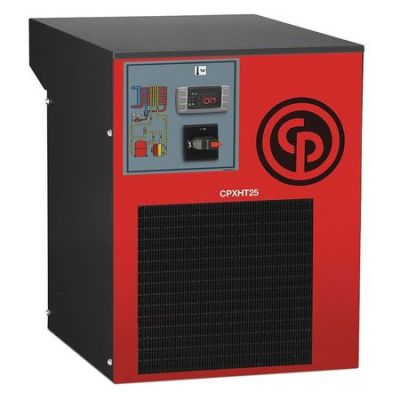
Chicago Pneumatic CPXHT50 (H2) 50 SCFM High-Temperature Refrigerated Air Dryer, 1" NPT, 115V/1Ph - PN 4102003869
High-Temperature Moisture Removal for 10 to 15 HP Reciprocating Air Compressors
The Chicago Pneumatic CPXHT50 High-Temperature Refrigerated Air Dryer, part number 4102003869, is engineered to remove moisture from compressed-air systems operating with elevated inlet-air temperatures.
Rated for 50 SCFM at 100 PSIG, the CPXHT50 can accept compressed-air inlet temperatures up to 180°F. This high-temperature capability makes it an excellent match for many 10 to 15 HP reciprocating air compressors, including systems that do not have a separate air-cooled aftercooler.
The CPXHT50 combines a refrigerated air dryer, moisture separator, and electronic condensate drain in one compact package. As hot compressed air passes through the dryer, it is cooled so water vapor condenses into liquid. The integrated separator removes the condensate from the airflow, while the electronic drain automatically discharges the collected moisture.
With a pressure dew point of approximately 50°F ± 2°F, the CPXHT50 helps reduce water accumulation inside compressed-air piping and protects pneumatic tools, cylinders, valves, production equipment, and finished products from moisture-related problems.
The dryer operates on standard 115-volt single-phase power and uses 1-inch NPT inlet and outlet connections, simplifying installation in automotive shops, fabrication facilities, maintenance departments, woodworking operations, and other commercial or light-industrial applications.
Manufacturer Part Number: 4102003869
Key Features and Benefits
50 SCFM Rated Capacity
The CPXHT50 is rated for 50 SCFM at 100 PSIG, making it suitable for many 10 to 15 HP reciprocating air compressor systems.
Actual dryer capacity can vary based on:
- Compressed-air inlet temperature
- Ambient temperature
- Operating pressure
- Airflow demand
- Required pressure dew point
Handles Inlet Temperatures Up to 180°F
The CPXHT50 is specifically designed to accept high-temperature compressed air produced by reciprocating compressors.
Its 180°F maximum inlet-air temperature can eliminate the need for a separately installed aftercooler when the dryer is properly sized for the application.
50°F Pressure Dew Point
The dryer provides a pressure dew point of approximately 50°F ± 2°F, helping reduce liquid water formation in downstream piping and equipment.
Integrated Moisture Separator
The built-in moisture separator removes condensed water from the compressed-air stream after it has been cooled.
Electronic Condensate Drain
An integrated electronic drain automatically discharges collected condensate, reducing manual maintenance and helping prevent moisture from accumulating inside the dryer.
Stainless Steel and Copper Heat Exchanger
The stainless steel and copper heat exchanger provides efficient thermal transfer while supporting dependable operation in demanding compressed-air environments.
115V Single-Phase Power
The CPXHT50 operates on 115V single-phase, 60 Hz electrical power, eliminating the need for specialized three-phase electrical service.
1-Inch NPT Connections
The dryer uses 1-inch NPT inlet and outlet connections, providing appropriate piping capacity for its 50 SCFM airflow rating.
Maximum Working Pressure of 232 PSIG
The CPXHT50 is rated for compressed-air systems operating at pressures up to 232 PSIG.
Compact Enclosed Design
Measuring approximately 18 inches long, 23 inches wide, and 31 inches high, the CPXHT50 provides high-temperature drying capability in a relatively compact footprint.
Quiet Operation
The internal component layout and enclosed cabinet help reduce operating noise, making the dryer suitable for installation near active work areas when proper ventilation is provided.
Helps Protect Pneumatic Equipment
Removing moisture from compressed air helps protect:
- Pneumatic tools
- Air cylinders
- Impact tools
- Tire-service equipment
- Paint equipment
- Regulators and valves
- Production machinery
- Automation components
- Compressed-air piping
Helps Improve Finished Product Quality
Dry compressed air can help reduce moisture-related problems in painting, finishing, fabrication, woodworking, assembly, and manufacturing applications.
Standard Features
- 50 SCFM rated airflow at 100 PSIG
- Maximum inlet-air temperature of 180°F
- 50°F pressure dew point, ±2°F
- Maximum working pressure of 232 PSIG
- 115V single-phase electrical power
- 60 Hz operation
- 1-inch NPT inlet and outlet connections
- Stainless steel and copper heat exchanger
- Integrated refrigerated air dryer
- Built-in moisture separator
- Electronic condensate drain
- Compact enclosed cabinet
- Air-cooled refrigeration system
- R-404A refrigerant
- Designed for high-temperature compressor discharge air
- Recommended for many 10 to 15 HP reciprocating compressors
- Minimum ambient temperature of 41°F
- Maximum ambient temperature of 113°F
Technical Specifications
| Specification |
Details |
| Manufacturer |
Chicago Pneumatic |
| Model |
CPXHT50 (H2) |
| Manufacturer Part Number |
4102003869 |
| Dryer Type |
High-temperature refrigerated air dryer |
| Rated Airflow |
50 SCFM |
| Rated Flow Conditions |
100 PSIG |
| Recommended Compressor Range |
10 to 15 HP |
| Pressure Dew Point |
50°F ± 2°F |
| Maximum Inlet-Air Temperature |
180°F |
| Minimum Ambient Temperature |
41°F |
| Maximum Ambient Temperature |
113°F |
| Maximum Working Pressure |
232 PSIG |
| Air Inlet Connection |
1-inch NPT |
| Air Outlet Connection |
1-inch NPT |
| Voltage |
115V |
| Phase |
Single phase |
| Frequency |
60 Hz |
| Heat Exchanger |
Stainless steel and copper |
| Moisture Separator |
Included |
| Electronic Condensate Drain |
Included |
| Refrigerant |
R-404A |
| Approximate Length |
18 inches |
| Approximate Width |
23 inches |
| Approximate Height |
31 inches |
| Approximate Weight |
108 pounds |
Recommended Applications
The Chicago Pneumatic CPXHT50 is well suited for:
- Automotive repair shops
- Collision repair and body shops
- Tire-service facilities
- Fleet-maintenance departments
- Metal fabrication shops
- Woodworking and cabinet shops
- Maintenance departments
- Light manufacturing
- Paint and finishing operations
- Pneumatic assembly equipment
- Air-operated production tools
- Commercial garages
- Packaging equipment
- Small production facilities
- Reciprocating air compressor systems
- 10 HP compressor applications
- 15 HP compressor applications
The dryer should be sized according to the compressor’s actual airflow, operating pressure, inlet-air temperature, and maximum ambient temperature.
Why Choose a High-Temperature Refrigerated Air Dryer?
Compressed air leaving a reciprocating compressor can be extremely hot. A standard refrigerated air dryer may not be designed to accept this elevated temperature without a separate aftercooler.
The CPXHT50 is designed to accept inlet-air temperatures up to 180°F, allowing it to handle hot discharge air from many reciprocating compressors.
Potential advantages include:
- May eliminate the need for a separate aftercooler
- Reduces installation complexity
- Saves floor space
- Reduces external piping requirements
- Automatically removes condensed moisture
- Helps protect downstream equipment
- Reduces water accumulation in air lines
- Reduces manual air-line purging
- Supports more consistent compressed-air quality
- Helps reduce moisture-related maintenance and downtime
Benefits of Dry Compressed Air
Atmospheric air naturally contains water vapor. When air is compressed, that moisture becomes concentrated. As the compressed air cools inside the receiver tank and distribution piping, the water vapor can condense into liquid.
Excessive moisture can contribute to:
- Internal piping corrosion
- Damaged pneumatic tools
- Sticking air cylinders
- Rust inside air receivers and piping
- Contaminated paint finishes
- Fisheye paint defects
- Damaged regulators and valves
- Increased equipment maintenance
- Reduced production quality
- Frozen outdoor air lines
- Unplanned downtime
The CPXHT50 cools the compressed air, separates condensed moisture, and automatically discharges the collected water.
Air Treatment Recommendations
A refrigerated air dryer primarily removes water vapor and condensed moisture. Some applications may require additional air treatment for particulate contamination, fine oil aerosols, odors, or other contaminants.
Depending on the application, the compressed-air system may also require:
- Automatic receiver-tank drain
- General-purpose particulate filter
- High-efficiency coalescing filter
- Activated-carbon filter
- Pressure regulator
- Oil-water separator
- Point-of-use air treatment
Paint spraying, instrumentation, and sensitive production applications may require additional treatment beyond a refrigerated air dryer.
Installation Considerations
The CPXHT50 should be installed indoors in a clean, well-ventilated location with adequate room for inspection and maintenance.
Before installation:
- Confirm that system airflow does not exceed the dryer’s 50 SCFM rated capacity.
- Verify that the dryer is suitable for the compressor’s actual inlet-air temperature.
- Confirm that operating pressure does not exceed 232 PSIG.
- Confirm that ambient temperature remains between 41°F and 113°F.
- Provide a 115V single-phase, 60 Hz electrical supply.
- Verify that the electrical circuit meets the dryer’s nameplate requirements.
- Use properly sized 1-inch compressed-air piping.
- Confirm the correct compressed-air flow direction.
- Keep the condenser and ventilation openings clear.
- Prevent heated exhaust air from recirculating into the dryer.
- Route the electronic drain discharge to an approved condensate collection or treatment system.
- Provide isolation valves to simplify future maintenance.
- Avoid unnecessary piping restrictions at the inlet and outlet.
- Support external piping so its weight is not carried by the dryer connections.
- Maintain the manufacturer’s recommended service clearances.
- Check the compressed-air system for leaks after installation.
Installation should be completed according to the supplied operating instructions and all applicable electrical, plumbing, and safety codes.
Routine Maintenance
Routine inspection helps maintain moisture removal, cooling performance, and dependable dryer operation.
Typical maintenance includes:
- Verify that the electronic condensate drain is operating.
- Inspect the drain discharge line for restrictions.
- Keep the condenser and ventilation openings clean.
- Remove accumulated dust and debris from cooling surfaces.
- Check the dryer for unusual noise or vibration.
- Inspect compressed-air fittings for leaks.
- Verify that inlet-air temperature remains within the rated limit.
- Confirm that ambient temperature remains within the allowable range.
- Inspect electrical wiring and connections.
- Check for excessive pressure drop through the dryer.
- Follow the maintenance instructions supplied with the unit.
Maintenance frequency can vary based on operating hours, dust levels, ambient temperature, humidity, and compressor operating conditions.
Basic Troubleshooting
Water Is Present Downstream
Check the electronic drain, drain discharge line, inlet-air temperature, airflow demand, ambient temperature, operating pressure, and dryer ventilation.
The dryer may be undersized if actual operating conditions exceed its rated capacity.
Electronic Drain Does Not Discharge
Check the drain’s electrical connection, timer operation, isolation valve, discharge tubing, and condensate outlet for blockages.
Dryer Does Not Start
Check the electrical outlet, circuit protection, power connection, dryer switch, and incoming voltage.
Dryer Runs but Does Not Remove Moisture
Verify that the refrigeration system is operating, the condenser is clean, the condensate drain is functioning, and inlet conditions remain within the dryer’s rated limits.
Excessive Pressure Drop
Inspect the compressed-air piping, valves, fittings, heat exchanger, and downstream air-treatment components for restrictions.
Dryer Shuts Down or Runs Hot
Check the ambient temperature, ventilation clearance, condenser cleanliness, and whether heated exhaust air is recirculating into the dryer.
Excessive Condensate in the Air System
Confirm that the air receiver is draining properly and that the dryer is installed and sized correctly for the compressor’s airflow and discharge temperature.
Refrigeration-system repairs, electrical repairs, internal pressure-system repairs, and major service should be completed by qualified personnel.
Frequently Asked Questions
What is the rated capacity of the CPXHT50?
The CPXHT50 is rated for 50 SCFM at 100 PSIG.
What is the manufacturer part number?
The manufacturer part number is 4102003869.
What makes this a high-temperature dryer?
The CPXHT50 can accept compressed-air inlet temperatures up to 180°F, allowing it to work with many reciprocating compressor systems without a separate aftercooler.
What size compressor is the CPXHT50 designed for?
It is recommended for many 10 to 15 HP reciprocating air compressors, provided the compressor’s actual airflow and operating conditions remain within the dryer’s capacity.
What pressure dew point does it provide?
The CPXHT50 provides a pressure dew point of approximately 50°F ± 2°F.
Does the dryer include a moisture separator?
Yes. The CPXHT50 includes an integrated moisture separator.
Does it include an automatic condensate drain?
Yes. The dryer includes an electronic condensate drain that automatically discharges collected moisture.
What electrical service is required?
The CPXHT50 requires 115V single-phase, 60 Hz electrical power.
What size are the air connections?
The dryer uses 1-inch NPT inlet and outlet connections.
What is the maximum operating pressure?
The maximum working pressure is 232 PSIG.
What is the allowable ambient temperature range?
The dryer is designed for ambient temperatures between 41°F and 113°F.
What refrigerant does the CPXHT50 use?
The CPXHT50 uses R-404A refrigerant.
Does this dryer remove oil?
The refrigerated dryer primarily removes moisture. Additional coalescing filtration may be needed to remove fine oil aerosols.
Does the CPXHT50 replace an aftercooler?
Its high-temperature design can eliminate the need for a separate aftercooler in properly sized applications with inlet temperatures up to 180°F.
Can this dryer be used for automotive painting?
Yes, provided it is properly sized. Paint applications may also require coalescing and point-of-use air treatment depending on the required finish quality.
Where should the condensate drain discharge be routed?
Condensate should be routed to an appropriate collection or oil-water separation system according to applicable regulations.
Why Buy from Compressed Air Advisors Online?
Compressed Air Advisors Online provides knowledgeable compressed-air equipment selection, system guidance, premium industrial products, and nationwide delivery.
Our team can help determine whether the Chicago Pneumatic CPXHT50 provides the correct capacity, inlet-temperature rating, operating pressure, connections, and electrical configuration for your compressed-air system.
When you need dependable air-treatment equipment backed by practical compressed-air knowledge, Compressed Air Advisors Online is your compressed-air partner.