

877.247.2381
MON-FRI, 8AM - 5PM CST
MON-FRI, 8AM - 5PM CST

Choosing an air compressor for a business takes more than matching a motor’s horsepower to a tool list. The compressor needs to deliver enough air at the required pressure, for the right length of time, with air quality that suits the process. Electrical supply, installation space, maintenance access, and long-term operating costs also affect whether the system will work well in a real facility.
This air compressor buying guide for businesses sets out a practical way to assess those needs. It covers airflow, pressure, duty cycle, compressor configuration, air treatment, installation, and ownership costs, so buyers can compare complete solutions rather than shopping by horsepower alone.
Airflow is commonly expressed in CFM (cubic feet per minute). For compressor selection, the useful figure is the air the machine can deliver at the required operating pressure, not just a general airflow number without context.
A practical demand review starts with the equipment that will use compressed air:
A diversity factor helps describe how much of the connected equipment is likely to run at once. It should reflect the real operating schedule, not an arbitrary discount applied to the tool list.
Illustrative example: A facility has four workstations, each with an air demand listed as 8 CFM in its equipment documentation. If operating records show that no more than three stations run at the same time, the combined station demand during that condition is 24 CFM. If all four can operate together during a particular task, the peak would instead be 32 CFM. Other loads, such as blow-off or purge air, would need to be added if they overlap.
The example uses hypothetical figures to show the method; it is not a product rating or a recommended compressor size. The key is that average demand and peak demand are different. Duty cycle can help estimate average consumption over time, but a brief high-demand event still has to be handled by compressor capacity, storage, or an appropriate system design.
Common mistake: Adding every tool’s maximum demand and buying a compressor based on that sum without checking whether all the tools can run together. The opposite mistake, assuming that tools rarely operate simultaneously without checking production behavior, can leave the system undersized.

The Chicago Pneumatic QRS 15 tank-mounted package is one example of equipment matched to a facility's airflow and pressure needs.
Pressure is measured in PSI (pounds per square inch). The required pressure should be based on the needs of the equipment at its point of use, not simply on the compressor’s maximum rating.
Pressure can drop as air passes through filters, dryers, separators, regulators, hoses, fittings, and piping. If a process needs a particular pressure at the machine, the system has to account for the losses between the compressor and that point. Those losses can vary with airflow, so a pressure check made during a quiet shift may not show what happens at peak demand.
A useful review includes pressure readings at the compressor, after treatment equipment, along the main header, and at critical equipment during representative operation. If a tool requires 90 PSI and measurements show an 8-PSI loss along its supply path under the relevant flow conditions, the pressure available upstream would need to account for that difference. That is a starting point for analysis, not a reason to raise pressure across the whole plant without further checking.
Rule of thumb: Investigate the source of a pressure drop before increasing the compressor setpoint. A restriction, undersized pipe, clogged filter, or poorly matched regulator may be the real issue.
Horsepower describes the motor’s power rating. It does not tell a buyer, by itself, how much usable compressed air a compressor will deliver at a specific pressure.
For an industrial air compressor selection, the more useful comparison is the manufacturer’s stated air delivery at the required operating pressure. Buyers should check that the compared ratings use consistent conditions and units. Product specifications should also be verified for the selected voltage, pressure setting, and configuration.
A compressor with more horsepower is not automatically the better choice. It may provide more output than the application needs, or its output may not match the facility’s pressure and duty-cycle requirements. A machine with less horsepower can also be unsuitable if it cannot sustain the required airflow during production.
When reviewing a product listing or quote, buyers should look for:
Duty cycle describes how much and how often a compressor is expected to operate. It should reflect the business’s actual schedule, including shifts, breaks, seasonal changes, and high-demand production periods. The manufacturer’s permitted operating conditions should also be checked.
A reciprocating, or piston, compressor compresses air using pistons moving inside cylinders. This type can suit some intermittent or smaller-scale applications, as well as operations with particular pressure requirements. Suitability depends on the model and operating schedule; a buyer should confirm that the selected machine is rated for the expected use.
Explore reciprocating air compressors, including the Saylor-Beall VT-735 vertical-tank package.

The Saylor-Beall VT-735, a two-stage reciprocating compressor available with a vertical tank, is one example of a vertical reciprocating package.
Rotary screw compressors are commonly used in facilities that need a steady supply of compressed air over longer operating periods. The right model still needs to match the facility’s airflow, pressure, air quality, and load profile.
Review rotary screw air compressors.
A fixed-speed compressor runs its motor at a set speed when operating. A variable-speed compressor adjusts motor speed within its designed operating range to respond to changing demand. The choice depends on how demand varies, the compressor’s operating range, and how it will work with other equipment and controls.
Variable-speed technology does not guarantee energy savings in every system. A load profile and equipment review can help determine whether a variable-speed model is appropriate.
Explore variable-speed compressors.
A tank-mounted compressor places the compressor on a receiver tank, creating a more integrated package. A base-mounted compressor is installed separately, allowing the receiver, dryer, and other treatment components to be arranged around the site’s layout and needs.
A package may simplify equipment placement, but the buyer should verify what is included and whether the receiver and treatment components are appropriate for the application. Compressed Air Advisors lists tank-mounted rotary screw compressors as one package option.
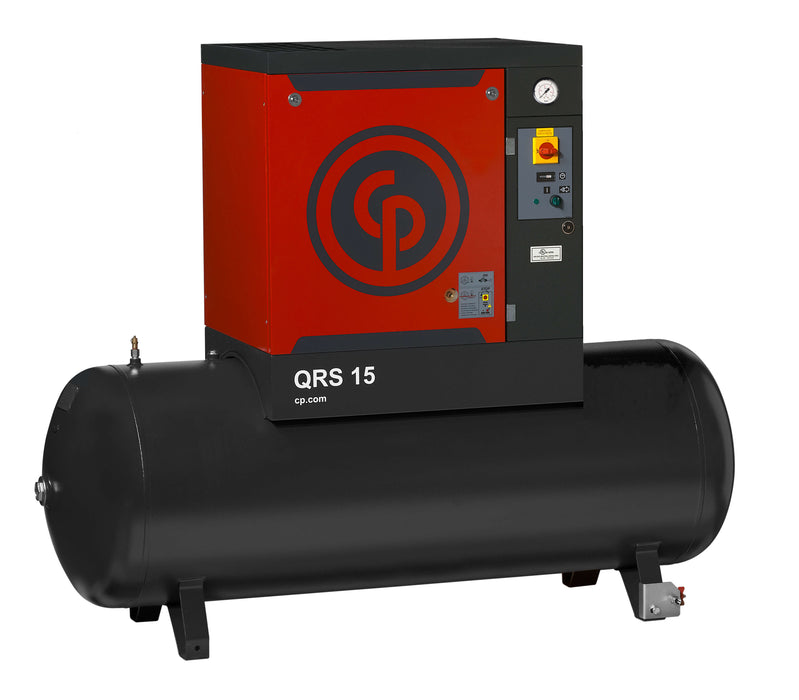
The Chicago Pneumatic QRS 15 125 TM is an example of a tank-mounted rotary screw package.
Oil-lubricated compressors use oil within the compression system. Oil-free designs are intended for applications where oil contamination in the compression chamber is a concern. Neither choice, on its own, defines the quality of the air delivered throughout the system. The process specification should determine the needed air treatment and verification.
Compressed air may contain moisture, particles, and oil-related contaminants. The correct treatment depends on how the air will be used. A general-purpose tool may have different requirements from a finishing process, sensitive instrumentation, or a product-contact application.
The ISO 8573-1 framework describes compressed-air purity in separate categories, including particles, water, and oil. It is a way to specify air quality more precisely than saying “clean air.” If a customer, process, or industry specification names a class, the full treatment system should be designed and verified against that requirement.
A compressed air system may use:

Refrigerated air dryers are one option for reducing moisture in compressed air.
The air-quality target should be set before equipment is chosen. Filters and dryers need to be correctly selected for the flow, pressure, temperature, and air-quality requirement.
Explore air dryers, read The Complete Air Dryer Buying Guide, and review in-line air filters and water separators.
A compressor must match the facility’s available electrical service. Before purchase, the buyer or qualified electrical professional should confirm the required voltage, phase, current, motor-starting needs, disconnects, and applicable electrical requirements. A compressor should not be selected on the assumption that the site can provide a different supply.
The installation area also affects reliable operation and service access. Before equipment is ordered, confirm:
For new or updated distribution piping, facilities can review aluminum compressed-air piping options. The correct pipe material and design should be confirmed for the operating pressure, temperature, and installation.
A compressor purchase is also a maintenance decision. Buyers should review the manufacturer’s service schedule and determine whether the facility can carry out routine maintenance or needs outside service support.
Before selecting a model, it helps to check:

OEM maintenance kits, filters, and service components are part of a compressor’s long-term ownership cost.
Dryers, filters, drains, and tanks also require inspection and service. Neglecting a filter or drain can affect air quality or pressure delivery, even if the compressor itself is operating normally.
Review condensate drain options and the compressed air receiver collection. A receiver tank can store air and support system operation, but its size and role should be determined from the demand pattern; it is not a substitute for adequate compressor capacity.
The purchase price is only one part of a compressor’s cost over time. For equipment that operates regularly, electricity use can be a major part of ownership cost. Maintenance labor, filters, oil where applicable, dryer operation, repairs, and production interruption should also be considered.
A useful comparison includes:
A lower initial price may not represent the lowest overall cost if the equipment does not match the application or is difficult to maintain. Conversely, a higher-cost configuration may not be justified if its features do not match the facility’s measured needs.
Facilities looking for ways to assess system waste can also read Reduce Compressed Air Energy Costs and Waste.
A facility manager or business buyer can use this sequence to organize an industrial air compressor buying guide for businesses into a workable selection process:
Before requesting equipment recommendations, a business can gather its existing compressor model, nameplate data, operating pressure, shift schedule, voltage and phase, air-treatment equipment, piping layout, and any known production changes. That information makes it easier to discuss the application and identify what still needs to be measured.
The first step is documenting the air demand: which equipment uses air, the pressure and airflow each requires, and which loads operate at the same time. The operating schedule and air-quality requirements should be recorded as well.
No. Horsepower is only one specification. The buyer should compare the compressor’s stated air delivery at the required pressure and confirm that the electrical and operating conditions match the facility.
The business should use equipment documentation and identify the loads that can run simultaneously. Duty cycle helps describe average use, while peak demand indicates the highest realistic airflow requirement. Measurements can help verify assumptions.
A diversity factor represents how much of the connected equipment is expected to operate at the same time. It should be based on the facility’s actual production pattern rather than an arbitrary reduction in the total tool demand.
No. A variable-speed compressor may suit a system with changing demand, but its effectiveness depends on its operating range, measured load profile, and interaction with other compressors. A system review should precede that choice.
An oil-free design may be considered when oil contamination in the compression chamber is a concern for the application. The process specification should determine the required air quality and any additional filtration or verification.
Not necessarily. Package contents vary by model. The buyer should confirm whether a tank, dryer, filters, drains, or other treatment components are included and whether they suit the specific airflow and air-quality requirements.
Pressure at the compressor may differ from pressure at the equipment because filters, dryers, hoses, regulators, and piping create pressure losses. Measuring at critical points helps distinguish a compressor-capacity issue from a distribution problem.
Yes, but the expected growth should be evaluated rather than covered by buying an oversized compressor without analysis. A staged plan or allowance for a future system addition may be worth comparing with a larger initial purchase.
The proposed equipment should be checked against actual demand, site conditions, and manufacturer specifications. A qualified compressed-air professional, engineer, or the equipment manufacturer can help verify important sizing and installation decisions.
The right commercial air compressor is the one that meets the facility’s real airflow, pressure, duty-cycle, and air-quality needs while fitting the site and the maintenance plan. Horsepower, tank size, and purchase price can help compare options, but none should replace a review of delivered air, system conditions, and total ownership costs.
A buyer can begin by exploring industrial compressors and the available air compressor collections. For help identifying suitable equipment options, contact Compressed Air Advisors. Final sizing and installation decisions should be verified against site measurements, manufacturer specifications, and advice from qualified professionals.