

877.247.2381
MON-FRI, 8AM - 5PM CST
MON-FRI, 8AM - 5PM CST

A compressor can show adequate discharge pressure while a production machine, pneumatic tool, or process receives too little. That difference may develop across air treatment equipment, distribution piping, or the final connections at the point of use. It can also appear only during heavy or intermittent demand, making a quick check at the compressor misleading.
A methodical pressure profile helps plant managers, facilities teams, and maintenance technicians locate where pressure falls and determine whether maintenance, component replacement, piping changes, or further investigation is appropriate. Here is how to approach compressed air system troubleshooting without treating higher compressor pressure as the automatic fix.
Pressure drop is the reduction in air pressure as compressed air moves through a system. Air encounters resistance from pipe walls, bends, valves, filters, dryers, regulators, hoses, fittings, and other components. When air is flowing, that resistance can create a pressure difference between the system’s supply and the point where the air is used.
The amount of loss is not necessarily constant. It depends on factors such as flow, temperature, component condition, and system configuration. As a result, pressure loss in compressed air piping or treatment equipment may become more noticeable when multiple machines operate at once or a process draws air in short bursts.
The U.S. Department of Energy’s Improving Compressed Air System Performance: A Sourcebook for Industry describes pressure drop as a loss between compressor discharge and the point of use. It advises assessing the system as a whole and checking equipment differentials against manufacturer specifications. The sourcebook also notes that a well-designed system should keep total pressure loss from receiver output to point of use much less than 10% of compressor discharge pressure. That is general design guidance, not a universal pass/fail limit for every system or application.
A compressor gauge reports pressure at its measurement location. It does not show what is happening farther downstream. Pressure may fall across a dryer or filter, along a long or restricted branch, and again through a regulator, hose, and quick disconnect before reaching a tool or machine.
A single reading can also miss a short pressure dip. If a high-demand machine runs intermittently, a gauge viewed between cycles may show an acceptable value even though the pressure falls during operation.
A useful distinction is:
The difference between readings at two locations is the pressure drop across the intervening section, provided measurements are taken under comparable flow conditions.
The likely source depends on where the system’s pressure profile shows the largest change.
| Component or area | Possible cause | What to check |
|---|---|---|
| Filters and separators | Loaded element, incorrect sizing, or flow beyond the component’s suitable range | Differential pressure, service history, and the manufacturer’s flow and pressure-drop data |
| Dryer and treatment equipment | Restriction, maintenance issue, or pressure loss through the equipment | Inlet and outlet pressure under flow; service requirements and specifications |
| Regulators | Regulator droop, restriction, unsuitable flow capacity, or an incorrect setting | Pressure upstream and downstream while air is flowing |
| Hoses and quick disconnects | Small internal passage, damage, excessive length, or unsuitable flow capacity | Condition, internal size, connections, and pressure at the equipment inlet |
| Piping and fittings | Undersized or long runs, many restrictions, partly closed valves, or contamination | Pressure at successive points, flow path, valve position, and piping condition |
| Demand and supply response | A short, high-flow event or changing demand | Pressure trends during the event and recovery afterward |
Filters and separators: A rising differential pressure across a filter can indicate a loaded element or a component operating outside its intended conditions. Measure the differential and compare it with the manufacturer’s limit. For replacement or selection, the application’s required air quality and actual flow conditions matter; the in-line air filters and water separators collection shows relevant component types, but product selection should be confirmed against system requirements.

Water separators and filter housings are common locations for measurable pressure loss, so their differential is often checked first.
Dryers: A pressure loss across a dryer should be checked alongside its operating condition and manufacturer’s documentation. The dryer should not be assumed to be the cause simply because it sits upstream of a low-pressure point.
Regulators: Regulators control downstream pressure, but their behavior under flow matters. A regulator that cannot maintain the required outlet pressure during demand may be undersized, restricted, malfunctioning, or affected by a restriction upstream. The pressure regulator collection is a useful reference for component types; an exact replacement requires checking the application and specifications.
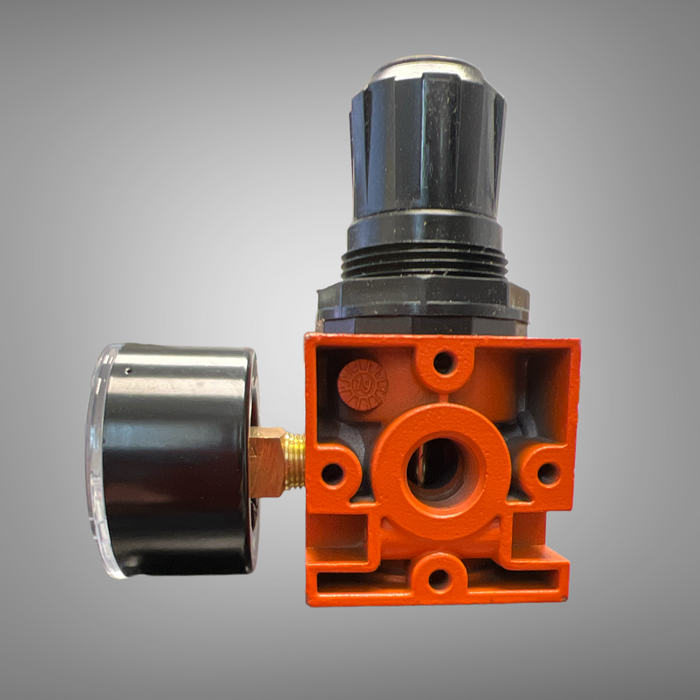
Regulator behavior under flow, not just at idle, determines whether it is supporting the required outlet pressure.
Hoses, fittings, and piping: A long, narrow hose or restrictive connection can contribute to an air compressor pressure drop close to the end use. Piping can also contribute when its size, layout, condition, or restrictions are not suitable for the actual flow. A low pressure reading at a tool does not, by itself, prove that the main piping is the problem.
A pressure profile is a set of pressure measurements taken at points along a compressed air system. It helps show where pressure declines rather than relying on a reading at the compressor alone.
A practical profile may include:
Matched, calibrated pressure gauges or differential-pressure gauges are appropriate tools. Measurements across a component should be taken at the same time where possible, or under closely comparable conditions. Pressure at the point of use should be observed while the equipment is drawing air, not only at idle. The compressed air pressure gauges collection shows gauge types used for this kind of measurement.
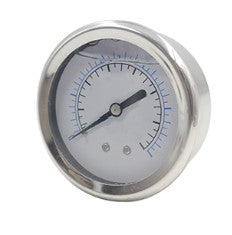
Comparable gauges at multiple points make a pressure profile easier to interpret.
A single snapshot can help locate a steady restriction, but it may miss intermittent demand. When pressure fluctuates or the problem appears only during production, pressure logging over representative operating periods can reveal dips, timing, and recovery. The DOE sourcebook discusses pressure profiles and data logging as tools for understanding system behavior over time.
Illustrative example: If pressure is acceptable at the receiver but falls between the treatment area and one machine branch during a production cycle, measurements at intermediate points can determine whether the larger drop occurs across a filter, regulator, hose, or piping section. The example is illustrative only; actual readings and acceptable limits depend on the system and equipment specifications.
The inspection should follow the measured pressure profile, from supply toward the affected equipment.
Some inspection and maintenance tasks require isolation, depressurization, and lockout procedures. Work on pressurized equipment should follow the manufacturer’s instructions and applicable safety rules; uncertain or hazardous work belongs with qualified personnel.
A low downstream reading can make several components look suspicious. The clearest lead is often the point where the measured pressure changes most under the relevant flow condition. That measurement does not by itself prove a component has failed, but it helps focus the next check. Confirm the finding against the component’s specifications and service history before ordering a replacement.
Increasing compressor discharge pressure may temporarily improve pressure at a distant point, but it does not identify or remove a restriction. A loaded filter, unsuitable hose, partly closed valve, or regulator issue may still be present.
Higher system pressure can also raise compressed-air demand at unregulated uses and leaks. The DOE sourcebook warns that increasing pressure to compensate for distribution losses can increase operating costs. Therefore, system pressure or compressor settings should not be changed without confirming process requirements, equipment limits, and appropriate professional guidance.
A better sequence is to locate the pressure loss, verify it under representative demand, and address the cause. Depending on the findings, appropriate action may include servicing a component, replacing an element, correcting a restriction, reviewing a regulator or hose, or evaluating piping improvements. If pressures fluctuate with sudden demand, a qualified system specialist may need to assess the broader supply, storage, and demand response.
Pressure drop prevention starts with a baseline. Recording pressure at consistent locations and operating conditions gives a facility a way to compare future readings and spot developing changes.
A practical maintenance routine can include:
The goal is not simply to maintain a particular pressure at the compressor. It is to supply the pressure and air quality required by the application throughout the system, with verified component performance and safe operating settings.
There is no single limit that applies to every system and application. The DOE sourcebook offers design guidance of much less than 10% of compressor discharge pressure between receiver output and point of use. Individual component differentials should also be compared with their manufacturers’ specifications.
Pressure loss often becomes more apparent as flow increases. A restriction that is less noticeable at idle may create a larger pressure difference when a machine draws air. Measurements should include the affected operating condition.
A loaded filter can contribute to pressure loss. Measuring across the filter while air is flowing and checking the reading against the manufacturer’s limit helps determine whether the filter is a likely source.
A regulator can contribute to low downstream pressure if it is restricted, not operating correctly, or unable to support the required flow conditions. Readings upstream and downstream during demand help distinguish regulator behavior from losses elsewhere.
Not as the first troubleshooting step. The pressure profile should be checked to locate restrictions and the tool’s required operating conditions should be confirmed. Changes to compressor settings require appropriate technical review.
Leaks increase air demand and may contribute to pressure instability, particularly when system supply cannot keep pace. A leak is not the same as a restriction, so facilities should investigate and document both.
Professional help may be appropriate when measurements are inconsistent, pressure swings affect production, work involves pressurized or electrical hazards, or system-wide changes to controls, storage, or piping are being considered.
Pressure loss can affect equipment performance and lead to unnecessary operating costs. Identifying restrictions in piping, filtration, regulators, and other system components is an important step toward improving compressed-air performance.
Compressed Air Advisors offers industrial compressors and related system components. Explore the available equipment or contact the team for help identifying products suited to your system requirements.